
Reviewed · ROCK-HEWN CHURCH TOURS
5 Days Lalibela-Danakil Tour
Erta Ale is the headline here: a volcano reached by a rough desert road, followed by a demanding climb to a crater with an active lava lake. Before that, you walk among Lalibela’s carved churches, then finish among salt flats, hot volcanic colors, and camel caravans in the Danakil Depression.
I like the way this trip joins two very different parts of Ethiopia in only five days. I also like the practical inclusions: domestic flights, Afar scouts and police, water, permits, camels, and a small maximum group of eight. The main drawback is the pace. Long drives, a hard overnight volcano outing, basic desert conditions, and some unclear timing make this a trip for fit, flexible people.
Key points to know before booking
- Two major Ethiopian sights in one trip: Lalibela’s medieval churches and the Danakil Depression make a powerful pairing.
- Erta Ale is physically demanding: The 80-kilometer approach from Dodom can take hours on rough tracks, followed by a climb and overnight camp.
- Small groups matter here: The maximum of eight helps with transport and coordination in remote Afar country.
- The price includes substantial logistics: At $900 per person, you get two Ethiopian Airlines domestic flights, accommodation, transport, meals listed in the plan, permits, guides, security, water, and desert support.
- Dallol and salt mining are seasonal sights: Camel caravans are not available in July, August, or early September.
- Communication deserves attention: Confirm pickup details, hotel names, flight times, and the daily plan before departure.
Why this five-day route works
This is not a relaxed Ethiopia holiday. It is a concentrated route built around two remarkable places that are far apart in character and geography.
Lalibela gives you carved stone, churches, religious tradition, and a compact historic center. Danakil gives you heat, salt, volcanic fire, and enormous empty spaces. The contrast is the point. In five days, you move from a highland cultural site to one of the hottest and lowest regions on Earth.
I like that the trip begins with Lalibela rather than rushing straight into the desert. The churches provide a cultural anchor before the hard physical days begin. You also avoid spending every day on the road by using domestic flights at the start and end.
The trip is priced at $900 per person. That is not a budget independent itinerary, but Danakil is difficult to arrange on your own. The cost covers two domestic flights, a vehicle, drivers, local and English-speaking guides, accommodation, entrance fees, licenses, security support, water, camels, and several meals.
That package has real value because the Danakil portion requires more than a standard sightseeing vehicle. The tour supplies an Afar guide, scout and police service, camel support, and camel tires. Those details matter in a remote region where roads, heat, and local access can complicate a simple-looking visit.
The listed rating is 4.6 from 11 ratings, with 91 percent recommending the experience. That points to a generally strong operation, especially for the planning and care involved. Still, one account describes a missed Addis Ababa pickup, and another points to weak communication about hotel and timing details. I would confirm every transfer directly before you fly.
Other church trips from Addis Ababa:
- 12 Days SIMIEN MOUNTAIN-LALIBELA-DANAKIL-TIGRAY CHURCHES
★ 5.0 · 45 reviews - 5 DAYS Lalibela, Axum, Tigray churches and Danakil
★ 5.0 · 34 reviews - Danakil Depression and Lalibela 5 Days Tours
★ 5.0 · 28 reviews
Day one: Lalibela’s churches in carved stone
You fly north from Addis Ababa to Lalibela in the morning, then transfer to your hotel. After lunch, the first church visit takes about five hours.
Lalibela is not a conventional church complex built on top of the ground. The churches were cut directly into the rock during the reign of King Lalibela, from 1181 to 1221. The site is a UNESCO World Heritage Site, and the buildings are arranged in groups around the town.
The first group lies north of a small stream called the Jordan River. You can expect to see Biete Medhanealem, Biete Maryam, Biete Golgotha Mikael, Biete Maskal, and Biete Denagel. Other churches listed for Lalibela include Biete Giyorgis, Biete Amanuel, Biete Qeddus Merkoreos, Biete Abba Libanos, Biete Gabriel-Ruphael, and Biete Lehem.
The names are worth knowing because this is more than a quick photo stop. Each church has its own shape, carved passages, and religious role. The most familiar image is often Biete Giyorgis, the cross-shaped church cut down into the rock, but the wider group gives you a better sense of the scale of the project.
I like that the tour allows a full afternoon rather than trying to squeeze Lalibela into an hour. Five hours gives you time to move between churches and absorb the setting without treating the site like a checklist.
The day does have limits. Lunch and dinner in Lalibela are not included, and your time in town is short. If you want an unhurried visit to every church, extra religious sites, or time to explore local life, five days will feel tight.
Day two: the long road from Lalibela to Mekele
Day two is a transfer day, with a drive of roughly seven to eight hours from Lalibela to Mekele.
This is the least sightseeing-focused part of the trip, but it serves an important purpose. Mekele is the practical staging point for the Danakil route. Instead of returning to Addis Ababa and losing more time, you continue overland toward the Afar region.
You should treat this as a full road day. Bring water, snacks, sun protection, and something to occupy you between stops. The air-conditioned vehicle is useful, but long Ethiopian road journeys can still be tiring, especially after the church visit and before the volcano outing.
This is also a good day to ask the guide for a clear schedule for days three through five. The supplied plan contains some inconsistent wording, including a Day Five heading that still refers to Erta Ale even though the activities describe salt mining, Dallol, and Lake Assal. That does not necessarily change the route, but it is a reason to confirm the sequence in person.
Day three: the rough approach to Erta Ale
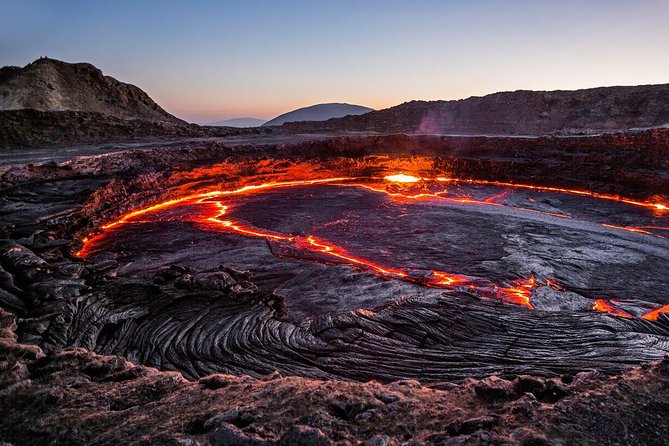
Erta Ale means smoky mountain in the Afar language. It is a shield volcano with a base about 30 kilometers wide, a summit caldera, and an elevation of about 613 meters. Its lava lake is the great draw.
The day begins with a drive toward Dodom, the settlement at the base of the volcano. The route covers about 80 kilometers, but the distance does not tell the whole story. The road is described as one of the roughest in the world, and the drive can take much longer than you might expect.
The written schedule gives a 9:00 a.m. start and about seven hours for the day’s activity. Expect the approach to be slow and demanding. Once you reach the base, you begin the trek across rock, sand, and open desert terrain toward the summit.
This is where physical fitness matters. The tour asks for a moderate fitness level, but I would read that as a minimum rather than a guarantee of comfort. You need to manage heat, uneven ground, a long approach, and an overnight stay near the crater. The climb is not presented as a technical mountaineering route, but it is still a serious outing.
The reward is the volcanic crater and, when conditions allow, the glow of the lava lake after dark. The plan describes Erta Ale as having one of the world’s few permanent lava lakes. Volcanic activity can change, and visibility is never something to take for granted, so keep expectations realistic.
Overnight camping on the volcano’s rim is one of the trip’s defining moments. Accommodation here is basic by design. You are choosing access and rarity over comfort. Bring warm layers for the night as well as light clothing for the heat, though the tour’s supplied details do not specify the exact camping equipment.
Other desert expeditions from Addis Ababa:
- 3 Day Danakil Depression Ertale and Dallol Tours
★ 5.0 · 44 reviews - 2-Night 3-Day Danakil Depression Tour without Flights
★ 4.8 · 31 reviews - 5 DAYS Axum, Lalibela, Tigray churches and Danakil
★ 4.5 · 22 reviews - 9 Days Tours To Danakil Depression, Simen MNP, Lalibela With Omo Valley Tribes
★ 5.0 · 11 reviews
Day four: sunrise, Afdera, and a possible salt lake visit
The volcano experience continues into the morning. You are scheduled to watch sunrise near the northern pit crater, then walk a few minutes to the southern and central pits.
The main crater is described as about 200 meters deep and 350 meters across. The southern pit is smaller, about 65 meters wide and roughly 100 meters deep. These measurements help explain why the sunrise stop is more than a scenic pause. You are looking into a broad volcanic structure shaped by collapse and fire.
The planned descent begins around 7:00 or 9:00 a.m., depending on the final schedule, with breakfast before returning to Dodom. That variation is worth confirming. Heat is a major factor in Afar, so early movement is sensible.
After the volcano, you reach camp by late morning and have time to rest. The route then continues toward Lake Giulietti, also called Lake Afdera. The plan lists this visit as optional and notes that it may not be available in some conditions.
Lake Afdera is valuable as a change of pace. After the rough tracks and volcanic rock of Erta Ale, a salt lake offers a broader, flatter setting. Do not build your entire decision around this stop, though. Since it is optional, weather, road conditions, or timing may remove it from the day.
The supplied package includes breakfast, lunch, and dinner allocations across the trip, but not every meal in every town. Specifically, lunch and dinner in Lalibela are excluded. Ask which meals are included on the Afdera day so you can plan cash and snacks.
Day five: salt miners, camels, Dallol, and Lake Assal
The final full day shows the human side of the Danakil route. At Ragad, also called Asebo, you visit salt-mining areas where workers break salt from the ground, cut it into rectangular pieces, and load it onto camels.
This is one of the most worthwhile stops because it connects the strange geology to ordinary work. Salt is not just a colorful surface here. It is collected, shaped, carried, and moved through a demanding desert trade route.
Camel caravans are part of the appeal, but timing matters. No camel caravans are available in July, August, or early September. If this scene is central to your plans, avoid those months or confirm current conditions before paying.
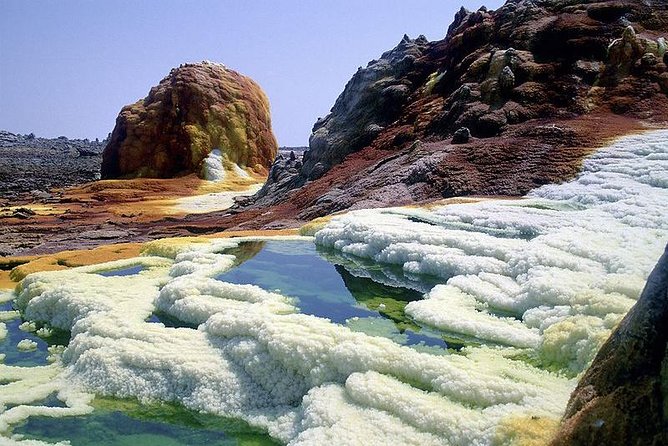
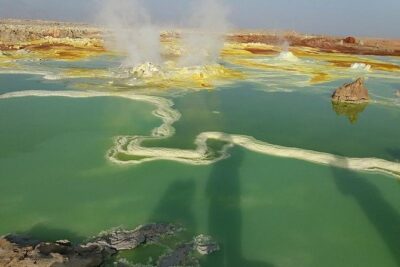
The route then continues to Dallol, about 116 meters below sea level. The area is known for volcanic activity and strongly colored salt formations. The tour also includes Lake Assal and time walking with Afar people.
Dallol can be visually intense: mineral colors, salt, heat, and volcanic features packed into one of the world’s most unusual settings. You should bring a hat, water, sturdy shoes, and sun protection. The tour supplies bottled water for the Danakil portion, but do not treat that as a reason to drink casually. Heat and long exposure can drain you quickly.
The wording of the final day says Erta Ale in the stop heading, but the actual description is the Dallol and salt-mining route. Confirm that the operator’s current schedule matches this sequence.
After the excursion, you drive back to Hamedela and continue to Mekele. The itinerary lists a 7:50 p.m. flight to Addis Ababa, with the Danakil tour ending there. The exact flight and transfer arrangements should be confirmed before departure.
What the $900 price really covers
At first glance, $900 may look high for five days in Ethiopia. The value becomes clearer when you separate ordinary sightseeing from the special logistics of Danakil.
Included are:
- Two domestic Ethiopian Airlines flights
- Accommodation throughout the trip
- Air-conditioned vehicle transport
- English-speaking guide and driver
- A local Afar guide
- Entrance fees and licenses
- Scout and police service in Afar
- Camels and camel tires
- Bottled water in Danakil
- Three lunches, two dinners, and four breakfasts
The package also limits the group to eight people. That is useful on rough roads and during early starts. A smaller group can make vehicle loading, guide communication, and changes in the field easier.
The price does not cover international flights, alcoholic drinks, camera or videographer fees, laundry, phone and internet charges, or personal purchases. Lunch and dinner in Lalibela are also excluded.
For me, the strongest part of the value is not the hotel component. It is the combination of flights, security support, local access, and desert transport. Danakil is the sort of destination where an apparently cheap arrangement can become expensive once you add permits, drivers, water, escorts, and the right vehicle.
Comfort, safety, and communication
This is a supported expedition, not a luxury tour. You receive a vehicle, guides, security staff, water, and accommodation, but Erta Ale still means rough roads and a basic camp.
The inclusion of Afar scouts and police service is important. It provides local support in a remote region and gives the group a structured way to visit places such as Dallol and the salt-mining areas.
You should have moderate physical fitness and be comfortable with heat, dust, long drives, uneven ground, and limited comfort. People who need precise schedules, polished hotels, or leisurely mornings may find the trip frustrating.
Communication is the clearest practical concern. Before leaving Addis Ababa, confirm the pickup point, especially if you arrive at an international or domestic terminal. One reported problem involved no one appearing for an Addis pickup, despite it being part of the plan. That is avoidable with a written confirmation and a local phone number.
Also confirm hotel names, departure times, the optional Afdera stop, camping arrangements, and the exact flight back to Addis Ababa. The operator, Ethio Travel And Tours, has received strong praise for arranging transfers and handling requests, but the mixed communication accounts mean you should still check details yourself.
You can cancel for a full refund if you do so at least three full days before the start time. Changes made within that period are not accepted, and poor weather can lead to a different date or a full refund.
Who should book this Ethiopia tour?
I would choose this trip if you want the major visual experiences of Danakil but also want a proper cultural and historic stop in the same journey. It suits active people who can accept hard travel in exchange for places few ordinary tours reach.
It is especially appealing if you want:
- A small group rather than a large coach
- Lalibela and Danakil in one route
- An organized Erta Ale visit with security support
- Salt mining and camel-caravan scenes
- Domestic flights included
- A five-day schedule from Addis Ababa
I would hesitate if you want a slow pace, full control over meal choices, dependable minute-by-minute timing, or comfortable camping. The route is efficient, but it is not gentle.
Final verdict: a strong match for adventurous first visits
I would book this tour for the route, not for comfort. Lalibela gives you extraordinary carved churches, while Erta Ale, Dallol, Lake Assal, and the salt mines provide a rare look at a living volcanic region and the people who work within it.
The strongest features are the small group, the included domestic flights, and the practical support in Afar. The main cautions are the rough road to Erta Ale, the physical demands, seasonal camel caravans, optional Afdera plans, and the need to confirm pickup and timing details.
If you can handle early starts, basic conditions, and a little schedule uncertainty, $900 is a fair price for the amount of transport and support involved. Confirm the details before departure, pack for both intense heat and a cool volcano night, and this five-day route can give you two of Ethiopia’s most unusual experiences without trying to arrange the difficult parts alone.
FAQ
Where does the tour start and end?
The tour starts in Addis Ababa, with pickup offered from the meeting point. It ends back in Addis Ababa after the listed flight from Mekele.
How long does the tour last?
The experience lasts approximately five days, with a listed start time of 6:00 a.m.
How many people can join the group?
The maximum group size is eight people.
Are domestic flights included?
Yes. Two domestic Ethiopian Airlines flights are included in the tour price.
Is the Erta Ale visit physically difficult?
Yes. The itinerary includes a rough drive to Dodom, a trek to the volcano, and overnight camping on the rim. Participants should have a moderate level of physical fitness.
Are camel caravans available all year?
No. The tour information says camel caravans are not available in July, August, and early September.
More 5-Day Experiences in Addis Ababa
- 5 Days North Ethiopia Tours
★ 5.0 · 23 reviews - 5 Days Omo Valley Tours
★ 5.0 · 15 reviews - 5 Days Tour to World Heritage–listed Harrar, Dire Dawa and Awash NATIONAL PARK
★ 4.5 · 10 reviews - 5 days Omo valley
★ 5.0 · 9 reviews
Just added out of Addis Ababa
- Yod Abyssinia Cultural Night: Dinner, Music, and Dance★ 5.0 · 7 reviews
- Locally crafted beer and wine tasting and nightlife in Addis tour★ 5.0 · 6 reviews
- Stunning Views Wonchi Crater Lake a Private Day Trip★ 5.0 · 3 reviews
- Two days Lake Wenchi and Menagesha Forest★ 5.0 · 3 reviews
- Tribes of the Ethiopian Omo Valley – 9 Day Tour★ 5.0 · 5 reviews
- Addis Ababa City Tours Full-Day Tours★ 5.0 · 5 reviews
- 3-Day Cultural Tour in South Omo Valley★ 5.0 · 4 reviews
- Day Trip to Tiya UNESCO Site & Melka Kunture Archaeological Site★ 4.5 · 3 reviews
Rock-Hewn Church Tours, compared.
12 Days SIMIEN MOUNTAIN-LALIBELA-DANAKIL-TIGRAY CHURCHES
Read our review →
Tour 11 monolithic rock churches & museum in Lalibela & cave church with mummies
Read our review →
Ethiopia Tigray Tours: Guided tour of Tigray rock hewn churches
Read our review →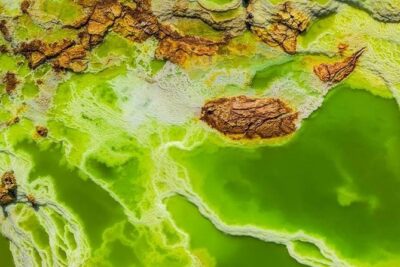
5 DAYS Lalibela, Axum, Tigray churches and Danakil
Read our review →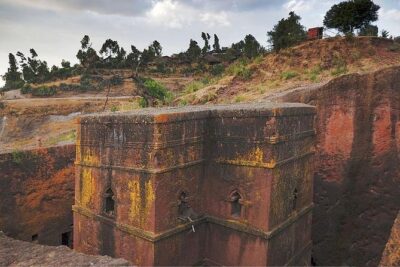
6 Days tour Package (Simien Mountains, Lalibela, and Danakil Depression)
Read our review →
Lalibela, Axum, Danakil and Omo Valley 8 DAYS
Read our review →Browse the lists this tour appears in